Improvements to a commercial DNA extraction method for high-quality nucleic acid extractions from Populus tremuloides Michx. vegetative buds
DOI:
https://doi.org/10.18387/polibotanica.60.12Palavras-chave:
populus tremuloides , isolation, DNA, PCR amplification, DNA integrityResumo
ABSTRACT
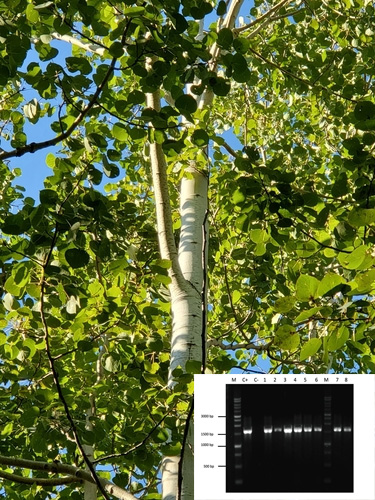
Populus tremuloides is a tree species of interest due to the potential discovery of an adaptive history in its genome, making the correct isolation of its DNA essential. This study examined two extraction methods based on the Nucleo Spin™ Plant II kit, using growth buds from eight samples. Method 1 used buffer PL1, a homogenizer, and a 15-minute incubation with RNase; method 2 employed buffer PL2, glass beads, and a 45-minute incubation with RNase. Afterwards, the DNA was amplified by PCR. Method 1 produced an average DNA concentration of 137.9 ng/µL and a 260/280 ratio of 1.8 but showed DNA fragmentation on gel, which can affect some analyses. Method 2, although with a lower concentration (65.9 ng/µL) and a 260/280 ratio of 1.77, presented a clear band on the gel, indicating better DNA integrity. PCR was successful in both cases, but the greater DNA integrity in method 2 suggests it is more suitable for studies requiring intact fragments. Although method 1 offers greater quantity and purity, method 2 is preferable when DNA integrity is critical for genomic analysis.
Referências
Aboul-Maaty, N. A. F., & Oraby, H. A. S. (2019). Extraction of high-quality genomic DNA from different plant orders applying a modified CTAB-based method. Bulletin of the National Research Centre, 43, 25. https://doi.org/10.1186/s42269-019-0066-1
Abubakar, B. M., Salleh, F. M., Wagiran, A., & Abba, M. (2021). Comparative evaluation of different DNA extraction methods from E. longifolia herbal medicinal product. eFood, 2(1), 21-26. https://doi.org/10.2991/efood.k.210202.001
Alejos, V. L., Aragón, M. D. C., & Cornejo, R. A. (2014). Extracción y purificación de ADN: herramientas moleculares aplicadas en ecología: Aspectos teóricos y prácticos. SEMARNAT-INECC. https://www2.congreso.gob.pe/sicr/cendocbib/con4_uibd.nsf/770DBBBD5ADF759505257D4900580FE6/$FILE/HerramientasMolecularesAplicadasEcolog%C3%ADa.pdf
Ambawat, S., Singh, S., Satyavathi, C. T., Meena, R., Meena, R. C., & Khandelwal, V. (2020). Development of a high quality, rapid, efficient and economical DNA extraction protocol from climate resilient pearl millet crop without liquid nitrogen. International Journal of Environment and Climate Change, 10(12), 85-94. https://doi.org/10.9734/ijecc/2020/v10i1230287
Ausubel, F. M., Brent, R., Kingston, R. E., Moore, D. D., Seidman, J. G., Smith, J. A., & Struhl, K. (2003). Current protocols in molecular biology. John Wiley & Sons Inc. https://hoclai.wordpress.com/wp-content/uploads/2015/09/current-protocols-in-molecular-biology.pdf
Bagley, J. C., Heming, N. M., Gutiérrez, E. E., Devisetty, U. K., Mock, K. E., Eckert, A. J., & Strauss, S. H. (2020). Genotyping-by-sequencing and ecological niche modeling illuminate phylogeography, admixture, and Pleistocene range dynamics in quaking aspen (Populus tremuloides). Ecology and Evolution, 10(11), 4609-4629. https://doi.org/10.1002/ece3.6214
Birkemoe, T., Nybakken, L., Andelic, M., Tangnæs, M. J., Sverdrup-Thygeson, A., Kauserud, H., & Jacobsen, R. M. (2022). Secondary metabolites and nutrients explain fungal community composition in aspen wood. Fungal Ecology, 59, 101115. https://doi.org/10.1016/j.funeco.2022.101115
Blonder, B., Graae, B. J., Greer, B., Haagsma, M., Helsen, K., Kapás, R. E., & Strimbeck, R. (2020). Remote sensing of ploidy level in quaking aspen (Populus tremuloides Michx.). Journal of Ecology, 108(1), 175-188. https://doi.org/10.1111/1365-2745.13296
Carey, S. J., Becklund, L. E., Fabre, P. P., & Schenk, J. J. (2023). Optimizing the lysis step in CTAB DNA extractions of silica-dried and herbarium leaf tissues. Applications in Plant Sciences, 11(3), e11522. https://doi.org/10.1002/aps3.11522
Crespo, A., Blanco, O., Cubero, O. F., Molina, M. C., & Cubas, P. (1999). Técnicas y métodos para la iniciación en el estudio de la evolución molecular con aplicaciones especiales para el análisis de los hongos liquenizados. Bot Complut, 23, 13-51. https://core.ac.uk/download/pdf/38807236.pdf
Dairawan, M., & Shetty, P. J. (2020). The evolution of DNA extraction methods. American Journal of Biomedical Science and Research, 8, 39-45. https://doi.org/10.34297/ajbsr.2020.08.001234
Demkina, A., Slonova, D., Mamontov, V., Konovalova, O., Yurikova, D., Rogozhin, V., Belova, V., Korostin, D., Sutormin, D., & Severinov, K. (2023). Benchmarking DNA isolation methods for marine metagenomics. Scientific Reports, 13, 22138. https://doi.org/10.1038/s41598-023-48804-z
Doyle, J. J., & Doyle, J. L. (1990). Isolation of plant DNA from fresh tissue. Focus, 12, 13-15. https://www.researchgate.net/profile/Adhityo_Wicaksono/post/Quick_Extraction_of_plant_DNA_does_anyone_have_protocol/attachment/59d642dcc49f478072eaba57/AS:273804717166592@1442291539148/download/Doyle%26Doyle_Focus_1990_CTAB.pdf
El-Ashram, S., Al Nasr, I., & Suo, X. (2016). Nucleic acid protocols: Extraction and optimization. Biotechnology Reports, 12, 33-39. https://doi.org/10.1016/j.btre.2016.10.001
García-Godos, P., & Cueva-Castillo, J. M. (2021). Variabilidad genética de 29 accesiones de quinua (Chenopodium quinoa Willd) peruana mediante marcadores AFLP y análisis multivariante. Scientia Agropecuaria, 12(1), 57-64. https://doi.org/10.17268/sci.agropecu.2021.01.06
Goessen, R., Isabel, N., Wehenkel, C., Pavy, N., Tischenko, L., Touchette, L., Giguère, I., Gros-Louis, M. C., Laroche, J., & Boyle, B. (2022). Coping with environmental constraints: Geographically divergent adaptive evolution and germination plasticity in the transcontinental Populus tremuloides. Plants People Planet, 4(6), 638-654. https://doi.org/10.1002/ppp3.10297
Hernández-Velasco, J., Hernández-Díaz, J. C., Simental-Rodríguez, S. L., Jaramillo-Correa, J. P., Gernandt, D. S., Vargas-Hernández, J. J., ... & Wehenkel, C. (2024). Causes of heterozygosity excess: The case of Mexican populations of Populus tremuloides. Plant Diversity. https://doi.org/10.1016/j.pld.2024.12.006
Jiao, L., Liu, X., Jiang, X., & Yin, Y. (2015). Extraction and amplification of DNA from aged and archaeological Populus euphratica wood for species identification. Holzforschung, 69(8), 925-931. https://doi.org/10.1515/hf-2014-0128
Kotchoni, S. O., & Gachomo, E. W. (2009). A rapid and hazardous reagent-free protocol for genomic DNA extraction suitable for genetic studies in plants. Molecular Biology Reports, 36, 1633-1636. https://doi.org/10.1007/s11033-008-9362-9
Kotchoni, S. O., Gachomo, E. W., & Jimenez-Lopez, J. C. (2011). A plant cocktail amenable for PCR-based genetic analysis in Arabidopsis thaliana. Molecular Biology Reports, 38, 5281-5284. https://doi.org/10.1007/s11033-011-0677-6
Li, J. L., Zhong, L. L., Wang, J., Ma, T., Mao, K. S., & Zhang, L. (2021). Genomic insights into speciation history and local adaptation of an alpine aspen in the Qinghai–Tibet Plateau and adjacent highlands. Journal of Systematics and Evolution, 59(6), 1220-1231. https://doi.org/10.1111/jse.12864
Méndez-Cea, B., Cobo, I., Pérez, A., García, I., Linares, J., & Gallego, F. (2019). DNA extraction and amplification from Pinaceae dry wood. Silvae Genetica, 68(1), 55-57. https://doi.org/10.2478/sg-2019-0010
Mitton, J. B., & Grant, M. C. (1996). Genetic variation and the natural history of quaking aspen. BioScience, 46(1), 25-31. https://doi.org/10.2307/1312652
Mock, K. E., Rowe, C. A., Hooten, M. B., Dewoody, J., & Hipkins, V. D. (2008). Clonal dynamics in western North American aspen (Populus tremuloides). Molecular Ecology, 17(22), 4827-4844. https://doi.org/10.1111/j.1365-294X.2008.03963.x
Porebski, S., Bailey, L. G., & Baum, B. R. (1997). Modification of a CTAB DNA extraction protocol for plants containing high polysaccharide and polyphenol components. Plant Molecular Biology Reporter, 15, 8-15. https://doi.org/10.1007/BF02772108
Qiu, D., Bai, S., Ma, J., Zhang, L., Shao, F., Zhang, K., Yang, Y., Sun, T., Huang, J., Zouh, Y., Galbraith, D., Wang, Z., & Sun, G. (2019). The genome of Populus alba x Populus tremula var. Glandulosa clone 84K. DNA Research, 26(5), 423-431. https://doi.org/10.1093/dnares/dsz020
R Core Team. (2021). R: A language and environment for statistical computing [Software]. R Foundation for Statistical Computing. https://www.R-project.org
Rache-Cardenal, L. Y., Albesiano-Hoyos, A. S., & Tall, H. (2022). Optimización de un método de extracción de ADN utilizando Subepidermis de Austrocylindropuntia y Opuntia-Opuntioideae. Revista de Investigación, Desarrollo e Innovación, 12(2), 305-314. https://doi.org/10.19053/20278306.v12.n2.2022.15273
Ramachandran, R., Vishnu, B., Gangaprasad, A., & et al. (2022). Effective and reliable protocol for DNA isolation from polyphenolic leaves and fruits of Garcinia gummi-gutta (L.) Robs. Proceedings of the National Academy of Sciences, India Section B: Biological Sciences, 92, 825-831. https://doi.org/10.1007/s40011-022-01356-0
Rogers, S. O., & Bendich, A. J. (1994). Extraction of total cellular DNA from plants, algae and fungi. En Plant Molecular Biology Manual (pp. 183-190). https://doi.org/10.1007/978-94-011-0511-8_12
Saiki, R. K., Gelfand, D. H., Stoffel, S., Scharf, S. J., Higuchi, R., Horn, G. T., Mullis, K. B., & Erlich, H. A. (1988). Primer-directed enzymatic amplification of DNA with a thermostable DNA polymerase. Science, 239(4839), 487-491. https://doi.org/10.1126/science.2448875
Sánchez-Hernández, R. S., Quiñones-Pérez, C. Z., Hernández-Díaz, J. C., Prieto-Ruíz, J. Á., & Wehenkel, C. (2022). Field trials to assess the growth, survival, and stomatal densities of five Mexican pine species and their hybrids under common plantation conditions. Forests, 13(11), 1791. https://doi.org/10.3390/f13111791
Särkinen, T., Staats, M., Richardson, J. E., Cowan, R. S., & Bakker, F. T. (2012). How to open the treasure chest? Optimising DNA extraction from herbarium specimens. PLoS ONE, 7(8), e43808. https://doi.org/10.1371/journal.pone.0043808
Schenk, J. J., Becklund, L. E., Carey, S. J., & Fabre, P. P. (2023). What is the “modified” CTAB protocol? Characterizing modifications to the CTAB DNA extraction protocol. Applications in Plant Sciences, 11(3), e11517. https://doi.org/10.1002/aps3.11517
Scobeyeva, V., Omelchenko, D., Dyakov, L., Konovalov, A., Speranskaya, A., & Krinitsina, A. (2018). Comparison of some plant DNA extraction methods. Russian Journal of Genetics, 54, 576-586. https://doi.org/10.1134/S1022795418050095
Shapiro, S. S., & Wilk, M. B. (1965). An analysis of variance test for normality (complete samples). Biometrika, 52(3-4), 591-611. https://doi.org/10.2307/2333709
Sharma, P., Joshi, N., & Sharma, A. (2010). Isolation of genomic DNA from medicinal plants without liquid nitrogen. Indian Journal of Experimental Biology, 48, 610-614. https://www.researchgate.net/publication/47154477_Isolation_of_genomic_DNA_from_medicinal_plants_without_liquid_nitrogen
Shields, J., Joo, J., Kim, R., & Murphy, H. (2013). Assessment of three commercial DNA extraction kits and a laboratory-developed method for detecting Cryptosporidium and Cyclospora in raspberry wash, basil wash and pesto. Journal of Microbiological Methods, 92(1), 51-58. https://doi.org/10.1016/j.mimet.2012.11.001
Snedecor, G. W., & Cochran, W. G. (1989). Statistical methods (8, Ed.). Iowa State University Press. https://doi.org/10.1017/S0021859600074104
Student. (1908). The probable error of a mean. Biometrika, 6(1), 1-25. https://doi.org/10.2307/2331554
Ueno, S., Ito, Y., Hasegawa, Y., & Moriguchi, Y. (2024). Developing simple DNA extraction and PCR-RFLP for MALE STERILITY 4 (MS4) gene in Cryptomeria japonica D. Don: Toward an environmentally friendly protocol. Tree Genetics & Genomes, 20(6), 1-7. https://doi.org/10.1007/s11295-024-01682-6
Verbylaite, R., Beisys, P., Rimas, V., & Kuusiene, S. (2010). Comparison of ten DNA extraction protocols from wood of European aspen (Populus tremula L.). Baltic Forestry, 16(1), 35-42. https://www.researchgate.net/publication/287677920_Comparison_of_Ten_DNA_Extraction_Protocols_from_Wood_of_European_Aspen_Populus_tremula_L
Wehenkel, C., Mariscal-Lucero, S. R., González-Elizondo, M. S., Aguirre-Galindo, V. A., Fladung, M., & López-Sánchez, C. A. (2020). Tall Pinus luzmariae trees with genes from P. herrerae. PeerJ, 8, e8648. https://doi.org/10.7717/peerj.8648
Yang, S., & Vinatzer, B. A. (2021). Draft genome sequence of Mortierella alpina strain LL118, isolated from an Aspen (Populus tremuloides) leaf litter sample. Microbiology Resource Announcements, 10(47), e00864-21. https://doi.org/10.1128/MRA.00864-21
Zhou, R., Jenkins, J. W., Zeng, Y., Shu, S., Jang, H., Harding, S. A., & Tsai, C. J. (2023). Haplotype‐resolved genome assembly of Populus tremula × P. alba reveals aspen‐specific megabase satellite DNA. The Plant Journal, 116(4), 1003-1017. https://doi.org/10.1111/tpj.16454
Zhu, H., Zhang, H., Xu, Y., Laššáková, S., Korabečná, M., & Neužil, P. (2020). PCR past, present and future. Biotechniques, 69(4), 317-325. https://doi.org/10.2144/btn-2020-0057
Downloads
Publicado
Licença
Copyright (c) 2026 POLIBOTANICA

Este trabalho está licenciado sob uma licença Creative Commons Attribution-NonCommercial-ShareAlike 4.0 International License.

Polibotánica por Departamento de Botánica de la Escuela Nacional de Ciencias Biológicas del Instituto Politécnico Nacional se distribuye bajo una Licencia Creative Commons Atribución-NoComercial-CompartirIgual 4.0 Internacional.