In vitro propagation of Morus alba L. calli as an alternative feed for silkworm (Bombyx mori) larvae
DOI:
https://doi.org/10.18387/polibotanica.60.11Palavras-chave:
Morus sp, tissue culture, sericulture, Bombyx moriResumo
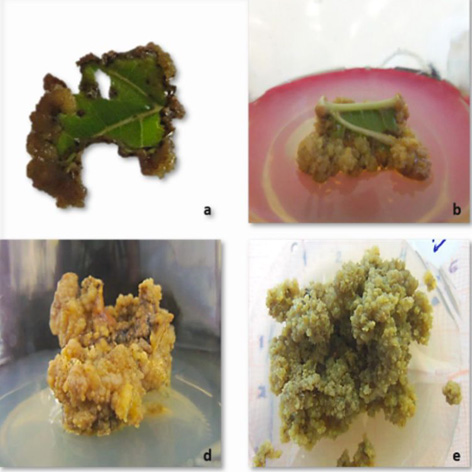
In vitro, propagation of plants is an attractive approach to multiply improved genotypes throughout the year in a disease-free manner. White mulberry (Morus alba L.) is a highly adaptable plant and its farming may rely on in vitro propagation under specific scenarios. Silk farming depends on white mulberry forage and such supply would benefit from in vitro propagation as a backup strategy to circumvent environmental challenges and plant diseases or pests. This study aimed to first compare the in vitro propagation of two varieties of white mulberry (SLP3 and SLP5) in a modified MS medium under four auxin supplementations in a completely randomize design (with 1.0 and 3.0 mgL-1 2,4-dichlorophenoxyacetic acid (2,4-D) and 1.0 and 3.0 mgL-1 thidiazuron (TDZ)) in the dark room for 60 days. Secondly, in vitro-grown calluses of white mulberry were tested as supplementary feed of silkworm (Bombyx mori) larvae for 35 days. The statistical analysis relied on analysis of variance and Tukey’s mean test, with a significance level of 5%. The variety SLP5 produced calluses with greater weight and volume than SLP3, while 3.0 mgL-1 2,4-D provided the best performance of in vitro-grown calluses, irrespective of variety and portion of the leaf used for propagation. Feeding silkworm larvae with in vitro-grown calluses did not affect their development (length and weight), irrespective of variety and auxin supplementation. In conclusion, in vitro propagation of white mulberry depends on interactions between variety and auxin supplementation, and in vitro grown calluses of white mulberry are attractive for feeding silkworm larvae.
Referências
Bamikole, M., Ikhatua, M., Ikhatua, U., & Ezenwa, I. (2005). Nutritive Value of Mulberry (Morus Spp.) Leaves in the Growing Rabbits in Nigeria. Pakistan Journal of Nutrition, 4, 231-236. doi: 10.3923/pjn.2005.231.236
Banday, M., Rasool Mir, M., Raja Reshi, R., Farooq Baqual, M., Lateef Khan, I., & Naqash, F. (2017). Floristic Composition and Phytosociology of Weed Flora of Mulberry (Morus spp.) Gardens of Kashmir Valley. International Journal of Pure and Applied Bioscience, 5(6), 1304-1311. doi:http://dx.doi.org/10.18782/2320-7051.5310
Benavides, J. E., Lachaux, M., & Fuentes , M. (1994). Efecto de la aplicación de estiércol de cabra en el suelo sobre la calidad y producción de biomasa de Morera (Morus sp.). En J. E. Benavides, Árboles y arbustos forrajeros en América Central (págs. 495-514). Turrialba, CR: CATIE.
Bhau, B. S., & Wakhlu, A. K. (2001). Effect of genotype, explant type and growth regulators on organogenesis in Morus alba. Plant Cell, Tissue and Organ Culture, 66, 25-29. doi:https://doi.org/10.1023/A:1010617212237
Bhatnagar, S., Kapur, A., & Khurana, P. (2001). TDZ-Mediated Differentiation in Commercially Valuable Indian Mulberry, Morus indica Cultivars K2 and DD. Plant biotechnology, 18(1), 61-65. doi:https://doi.org/10.5511/plantbiotechnology.18.61
Bobis, O., Dezmirean, D. S., Marghitas, L. A., Bonta, V., Urcan, A., Pasca, C., & Moise, A. R. (2018). Morus sp. for revigorating silkworm breeding in romania and promoting health benefits of leaves and fruits. Scientific Papers. Series B, Horticulture., LXII, 211-216. Obtenido de https://horticulturejournal.usamv.ro/pdf/2018/Art36.pdf
Caccam, M. M., & Mendoza, T. C. (2015). Improving Mulberry (Morus alba L.) Leaf Yield and Quality to Increase Silkworm Productivity in Northern Luzon, Philippines. Annals of Tropical Research, 37(1), 1-25. doi:https://doi.org/10.32945/atr3711.2015
Cholo Masapanta, L. F., & Delgado Rodríguez, H. B. (2011). Formación de callos en el cultivo de la morera (Morus alba L.). (Tesis de Licenciatura). Universidad de Granma, Faculta de Ciencias Agrícolas, Bayamo, Cuba. Obtenido de https://repositorio.utc.edu.ec/server/api/core/bitstreams/d39b0a62-12ed-49a9-bcbc-f01d42e25b2e/content
Espinosa, A., Silva, J., Sariego, S., Cholo Masapanta, L., & Delgado, H. (2012). Effect of explant type and concentration of 2,4-dichlorophenoxyacetic acid on callus formation in Morus alba L. Pastos y Forrajes, 35(4), 407-416. Obtenido de http://scielo.sld.cu/scielo.php?script=sci_arttext&pid=S0864-03942012000400006
Fonseca-Carrasco, Y. Y., Brizuela-Fuentes, L., & Silva-Pupo, J. J. (2020). Obtainment of calluses from Morus alba L. var. acorazonada with different culture media and explant types. Pastos y Forrajes, 43(1), 63-70. Obtenido de http://scielo.sld.cu/scielo.php?script=sci_arttext&pid=S0864-03942020000100066
Freire-Seijo, M. (2003). Aspectos básicos de la embriogénesis somática. Biotecnología Vegetal, 3(4), 195-209. Obtenido de https://revista.ibp.co.cu/index.php/BV/article/view/263/html
Freschi, L., Takahashi, C. A., Cambui, C. A., Semprebom, T. R., Bertinatto Cruz, A., Tamoso Mioto, P., . . . Mercier, H. (2010). Specific leaf areas of the tank bromeliad Guzmania monostachia perform distinct functions in response to water shortage. Journal of Plant Physiology, 526-533. doi:https://doi.org/10.1016/j.jplph.2009.10.011
Geetha, T., & Murugan, N. (2017). Plant Growth Regulators in Mulberry. Annual Research & Review in Biology, 13(3), 1-11. doi:https://doi.org/10.9734/ARRB/2017/29637.
Ikechu, M., Sugimoto, K., & Iwase, A. (2013). Plant Callus: Mechanisms of Induction and Repression. The Plant Cell, 25(9), 3159-3173. doi:https://doi.org/10.1105/tpc.113.116053
Islam, M. R., Siddiqui, M. N., Khatun , A., Siddiky, M. N., Rahman, M. Z., Bostami, A. M., & Selim, A. S. (2014). Dietary effect of Mulberry leaf (Morus alba) meal on growth performance and serum cholesterol level of broiler chickens. SAARC Journal of Agriculture, 79-89. doi:https://doi.org/10.3329/sja.v12i2.21920
Jain, A. K., & Datta, R. K. (1992). Shoot organogenesis and plant regeneration in mulberry (Morus bombycis Koidz): Factors influencing morphogenetic potential in callus cultures. Plant Cell, Tissue and Organ Culture, 29, 43-50. doi:https://doi.org/10.1007/BF00036145
Koyunco, F., Cetinbas, M., & Erbal, Í. (2014). Nutritional constituents of wild-grown black mulberry (Morus nigra L.). Journal of Applied Botany and Food Quality, 87. doi:https://doi.org/10.5073/JABFQ.2014.087.014
Kumar, V., Kodandaramaiah, J., & Rajan, M. V. (2012). Leaf and anatomical traits in relation to physiological characteristics in mulberry (Morus sp.) cultivars. Turkish Journal of Botany, 683-689. doi:https://doi.org/10.3906/bot-1003-48
Liang, L., Wu, X., Zhu, M., Zhao, W., Li, F., Zou, Y., & Yang, L. (2012). Chemical composition, nutritional value, and antioxidant activities of eight mulberry cultivars from China. Pharmacogn Mag, 8(31), 215-24. doi:https://doi.org/10.4103/0973-1296.99287
Ljubojević, M., Šavikin, K., Zdunić, G., Bijelić, S., Mrđan, S., Kozomara, M., . . . Narandžić, T. (2023). Selection of Mulberry Genotypes from Northern Serbia for ‘Ornafruit’ Purposes. Horticulturae, 9(1), 1-14. doi:https://doi.org/10.3390/horticulturae9010028
Mallick , P., & Sengupta, M. (2022). Prospect and Commercial Production of Economically Important Plant Mulberry (Morus Sp.) Towards the Upliftment of Rural Economy. En S. Gupta, & P. Chaturvedi, Commercial Scale Tissue Culture for Horticulture and Plantation Crops (págs. 219-243). Singapore: Springer. doi:https://doi.org/10.1007/978-981-19-0055-6_10
Milera, M., Sánchez, T., & Martín , G. (2010). Morus sp. para la alimentación de bovinos en desarrollo. Pastos y Forrajes, 33(1), 73-79. Obtenido de http://scielo.sld.cu/scielo.php?script=sci_arttext&pid=S0864-03942010000100006
Murashige, T., & Skoog, F. (1962). A Revised Medium for Rapid Growth and Bio Assays with Tobacco Tissue Cultures. Physiologia Plantarum, 15(3), 473-497. doi:https://doi.org/10.1111/j.1399-3054.1962.tb08052.x
Özgen, M., Serce, S., & Kaya, C. (2009). Phytochemical and antioxidant properties of anthocyanin-rich Morus nigra and Morus rubra fruits. Scientia Horticulturae, 119(3), 275-279. doi:https://doi.org/10.1016/j.scienta.2008.08.007
Pierik, R. L. (1990). Cultivo in vitro de las plantas superiores. Madrid, España: Mundi-Prensa.
Rahman, M. S., & Islam, S. M. (2021). Studies on Food, Health and Environmental Perspectives In Mulberry (Morus Spp.) – A Review. Journal of Bio-Science, 29(1), 163-179. doi:https://doi.org/10.3329/jbs.v29i0.54832
Rodríguez Ortega, A., Vargas Moter, J., Ventura Maza, A., Martínez Menchaca, A., Rodríguez Martínez, J., Muhammad, E., & Lara Viveros, F. M. (2012). Manual de sericultura en Hidalgo. México: UPFIM. Obtenido de https://upfim.edu.mx/wp-content/investigacion/libros/Libro%202012%20Manual%20de%20Sericultura%20en%20Hidalgo.pdf?_t=1686948044
Rodríguez-Ortega, A., Martínez-Menchaca, A., Ventura-Maza, A., Vargas-Monter, J., Ehsan, M., & Lara Viveros, F. M. (2013). Evaluación de variedades de morera en la alimentación del gusano de seda (Bombyx mori) en Hidalgo, México*. Revista mexicana de ciencias agrícolas, 4(5), 701-712. Obtenido de https://www.scielo.org.mx/scielo.php?script=sci_arttext&pid=S2007-09342013000500004
Sahoo, Y., Pattnaik, S. K., & Chand, P. K. (1997). Plant regeneration from callus cultures of Morus indica L. derived from seedlings and mature plants. Scientia Horticulturae, 69(1-2), 85-98. doi:https://doi.org/10.1016/S0304-4238(96)00980-6
Sánchez, M. (2000). Mulberry: an exceptional forage available almost worldwide! World Animal Review, 93(1), 1-21. Obtenido de chrome-extehttps://citeseerx.ist.psu.edu/document?repid=rep1&type=pdf&doi=80483ccd819586471d8e8a565a59a95411e7ceec
Sánchez, M. D. (2002). Mulberry for Animal Production. World distribution and utilization of mulberry and its potential for animal feeding. 147, págs. 1-9. Roma: Food and Agriculture Organization of the United National. Obtenido de Food and Agriculture Organization of the United Nations, Proceedings of an electronic conference: https://www.fao.org/4/x9895e/x9895e02.htm#bm02
Sharma, K. K., & Thorpe, T. A. (1990). In vitro propagation of mulberry (Morus alba L.) through nodal segments. Scientia Horticulturae, 42(4), 307-320. doi:https://doi.org/10.1016/0304-4238(90)90054-I
Sharma, P., & Sharma, R. A. (2013). Comparative Antimicrobial Activity and Phytochemical Analysis of Datura stramonium L. Plant Extracts and Callus In vitro. European Journal of Medicinal Plants, 3(2), 281-287. doi:https://doi.org/10.9734/EJMP/2013/2284.
Sil, S. K. (2021). Influence of Auxin and Cytokinin on Callus Induction of Mulberry. Annals of the Romanian Society for Cell Biology, 25(4), 2310-2318. Obtenido de https://www.proquest.com/openview/dbc595157f3d981e1584af7d39ec8280/1?pq-origsite=gscholar&cbl=2031963
Taha, H., Ghazy, U. M., Gabr, A. M., EL-Kazzaz, A. A., Ahmed, E. M., & Haggag, K. M. (2020). Optimization of in vitro culture conditions affecting propagation of mulberry plant. Bulletin of the National Research Centre, 44, 1-9. doi:https://doi.org/10.1186/s42269-020-00314-y
Thomas, T. D. (2002). Advances in mulberry tissue culture. Journal of Plant Biology, 45, 7-21. doi:https://doi.org/10.1007/BF03030427
Vijayan, K., Tikader, A., & Teixeira da Silva, J. A. (2011). Application of Tissue Culture Techniques for Propagation and Crop Improvement in Mulberry (Morus spp.). Tree and Forestry Science and Biotechnology, 5(1), 1-13. Obtenido de chrome-extension://efaidnbmnnnibpcajpcglclefindmkaj/http://www.globalsciencebooks.info/Online/GSBOnline/images/2011/TFSB_5(SI1)/TFSB_5(SI1)1-13o.pdf
Zach, A., Trull, H. E., Ortiz, M. L., Brem, J. J., & Brem, J. C. (2017). Degradación ruminal de materia seca de Morus sp en caprinos en diferentes estaciones del año. Revista Veterinaria, 28(2), 141-144. Obtenido de https://www.scielo.org.ar/pdf/revet/v28n2/v28n2a10.pdf
Downloads
Publicado
Edição
Seção
Licença
Copyright (c) 2026 POLIBOTANICA

Este trabalho está licenciado sob uma licença Creative Commons Attribution-NonCommercial-ShareAlike 4.0 International License.

Polibotánica por Departamento de Botánica de la Escuela Nacional de Ciencias Biológicas del Instituto Politécnico Nacional se distribuye bajo una Licencia Creative Commons Atribución-NoComercial-CompartirIgual 4.0 Internacional.