The Buxaceae family in Mexico
DOI:
https://doi.org/10.18387/polibotanica.60.1Keywords:
Taxonomy, Systematics, Flora of Mexico, Conservation, Buxus, SealyaAbstract
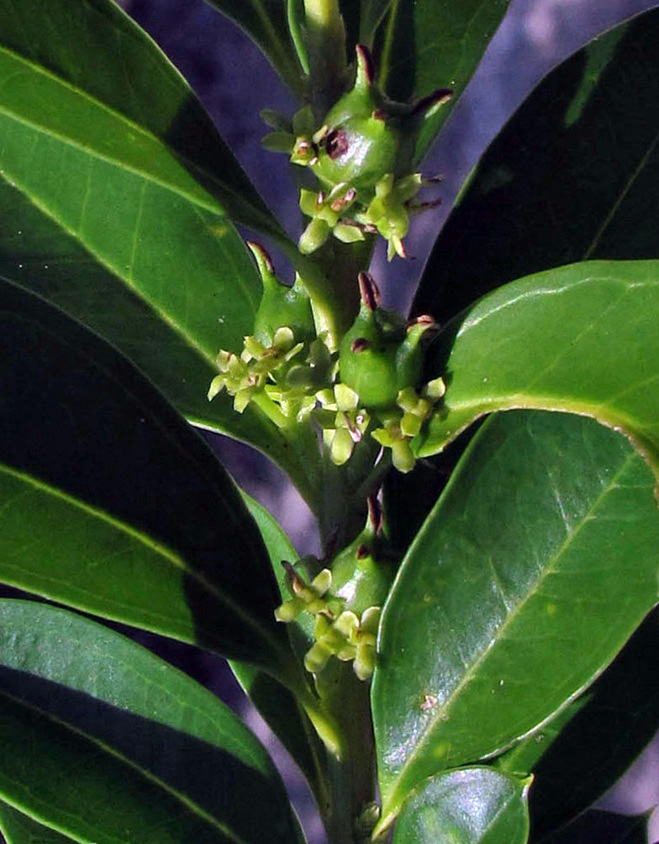
The Buxaceae, a family mainly composed of shrubs and small trees with a wide global distribution, displays a distinctive diversity in Mexico. This study reviews its national representation through bibliographic research, field observations, and critical examination of approximately three hundred herbarium specimens. Six species grouped into two genera are recognized: Buxus—with B. bartlettii, B. lancifolia, B. mexicana, B. moctezumae, and B. pubescens—and Sealya, a monotypic genus represented by S. conzattii, endemic to Oaxaca and Chiapas. The formal validation of Sealya represents a significant contribution, confirming a Mesoamerican lineage clearly distinct from Asian Sarcococca. The revision clarified diagnostic morphological characters, updated nomenclature, and provided identification keys. From a biogeographic perspective, most species are associated with humid montane forests and sub-evergreen tropical forests, with notable exceptions such as B. mexicana, adapted to xerophytic environments, and B. pubescens, restricted to the Islas Marías. These findings highlight the need for conservation strategies, since several species have narrow distributions and vulnerable habitats. This work establishes a robust taxonomic and biogeographic framework for future studies in systematics, phylogeny, and conservation of Buxaceae in Mexico.
References
Angiosperm Phylogeny Group. (2003). An update of the Angiosperm Phylogeny Group classification for the orders and families of flowering plants: APG II. Botanical Journal of the Linnean Society, 141(4), 399-436.
Berendsohn, W. G., Gruber, A. K., & Monterrosa Salomón, J. A. (2009). Nova Silva Cuscatlanica, Árboles nativos e introducidos de El Salvador. Parte 1: Angiospermae - Familias A a L. Englera, 29(1), 1-438.
Brückner, P. (1993). Pollen morphology and taxonomy of Eurasiatic species of the genus Buxus (Buxaceae). Grana, 32(2), 65-78.
Carnevali, G., Tapia-Muñoz, J. L., Duno de Stefano, R., & Ramírez Morillo, I. (2010). Flora ilustrada de la Península de Yucatán: Listado florístico. Centro de Investigación Científica de Yucatán, A.C.
Cronquist, A. (1981). An integrated system of classification of flowering plants. Columbia University Press.
Fernández-Nava, R. (1994). Buxaceae. En J. Rzedowski & G. Calderón de Rzedowski (Eds.), Flora del Bajío y de Regiones Adyacentes (Fascículo 27, pp. 1-6). Instituto de Ecología, A.C.
Floden, A., & Shipunov, A. (2016). Validation of the genus Sealya (Buxaceae). Phytoneuron, 2016-79, 1-3.
Gentry, A. H., Standley, P. C., & Steyermark, J. A. (1966). Flora of Guatemala. Fieldiana, Botany, 24, 1-434.
Gual, M., Cuevas-Reyes, P., González-Rodríguez, A., & Oyama, K. (2013). Distribution and ecological niche modeling of Mexican cloud forests: A case study with endemic species. Revista Mexicana de Biodiversidad, 84(2), 401-413.
Hans, A. S. (1973). Chromosomal conspectus of the Euphorbiaceae. Taxon, 22(5-6), 591-636.
Hegnauer, R. (1964). Chemotaxonomie der Pflanzen (Vol. 3). Birkhäuser Verlag.
Hegnauer, R. (1989). Chemotaxonomie der Pflanzen (Vol. 8). Birkhäuser Verlag.
Holmgren, P. K., Holmgren, N. H., & Barnett, L. C. (1990). Index Herbariorum. Part I: The herbaria of the world (8ª ed.). New York Botanical Garden.
Huang, S. F., Chen, Z. Y., Chen, S. J., Qi, Q. Y., & Shi, X. H. (1986). Plant chromosome counts (2). Subtropical Forest Science and Technology, 3, 41-47.
Jiménez-Ramírez, J., & Cruz-Durán, R. (2024). Buxaceae. En L. O. Alvarado-Cárdenas, J. Jiménez, R. M. Fonseca, & M. Martínez (Eds.), Flora de Guerrero (Fascículo 101, pp. 1-12). Prensas de Ciencias, Facultad de Ciencias, Universidad Nacional Autónoma de México.
Köhler, E. (1981). Pollen morphology of the West Indian–Central American species of the genus Buxus L. (Buxaceae) with reference to taxonomy. Pollen & Spores 23: 37–91.
Köhler, E., & Schirarend, C. (1989). Zur Blattanatomie der neotropischen Buxus-Arten und ihre Bedeutung für die Systematik (Buxaceae). Flora, 183, 1-38.
Köhler, E. (2007). Buxaceae. En K. Kubitzki (Ed.), The families and genera of vascular plants: Vol. IX (pp. 40-47). Springer.
Köhler, E. (2014). Buxaceae. En W. Greuter & R. Rankin Rodríguez (Eds.), Flora de la República de Cuba, Serie A, Plantas vasculares (Fascículo 19). Botanischer Garten & Botanisches Museum Berlin-Dahlem.
Köhler, E., & Brückner, P. (1982). Die Pollenmorphologie der afrikanischen Buxus- und Notobuxus-Arten (Buxaceae) und ihre systematische Bedeutung. Grana, 21(2), 71-82.
Mathou, T. (1940). Recherches sur la famille des buxacées. Université de Toulouse, Toulouse.
Medina, R. (2009). Buxaceae. En R. Medina Lemos (Ed.), Flora del Valle de Tehuacán-Cuicatlán (Fascículo 74, pp. 1-5). Universidad Nacional Autónoma de México, Instituto de Biología.
Standley, P. C. (1923). Trees and shrubs of Mexico. Contributions from the United States National Herbarium, 23, 1-1721.
Stevens, P. F. (2001 en adelante). Angiosperm Phylogeny Website (Versión 14). Missouri Botanical Garden. http://www.mobot.org/MOBOT/research/APweb/
Van Laere, K., Hermans, D., Leus, L. & Van Huylenbroek, J. (2011). Genetic relationships in European and Asiatic Buxus species based on AFLP markers, genome sizes and chromosome numbers. Plant Systematics and Evolution 293(1-4), 1-11.
Downloads
Published
License
Copyright (c) 2026 POLIBOTANICA

This work is licensed under a Creative Commons Attribution-NonCommercial-ShareAlike 4.0 International License.

Polibotánica by Departamento de Botánica de la Escuela Nacional de Ciencias Biológicas del Instituto Politécnico Nacional se distribuye bajo una Licencia Creative Commons Atribución-NoComercial-CompartirIgual 4.0 Internacional.