Ecological characterization of the fruiting area of the pine white mushroom (Tricholoma mesoamericanum) in “El Guajolote” Hidalgo, Mexico
DOI:
https://doi.org/10.18387/polibotanica.60.7Keywords:
Climate, forest, pine, TricholomaAbstract
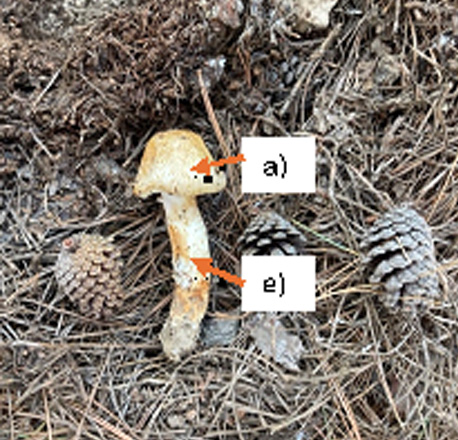
The objective of this study was to determinate the ecological and environmental factors in the forest area “El Guajolote” Epazoyucan, Hidalgo, that favors the proliferation of the mushroom Tricholoma mesoamericanum. This forest area counts with a mixed pine-oak forest with a great predominance of Pinus teocote the natural host of the fungal specie studied, the ecological and environmental factors were determined at four sites where this mushroom proliferated, as well as the gathering of fungal samples for the description of its macroscopic characteristics. It was found that the proliferation sites have a great abundance of P. teocote, P. patula and P. greggii, with respect to the shrub stratum the species Quercus greggii and Q. microphylla were found. The environmental conditions of the forest area in terms of temperature and precipitation correspond to 12.3 °C and 719.8 mm, respectively. The present study constitutes the first record of the ecological and environmental conditions of the forest area “El Guajolote” where the proliferation of T. mesoamericanum shows a wide preference to the southwest exposure, although its presence in other orientations is not ruled out, as long as the temperature and precipitation conditions recorded in this study are met.References
Aguirre-Acosta, E., Ulloa, M., Aguilar, S., Cifuentes, J. & Valenzuela, R. (2014). Biodiversidad de hongos en México. Revista mexicana de biodiversidad, 85(SUPPL.), S76–S81. https://doi.org/10.7550/RMB.33649
Antúnez, P., Serrano, P. M. L., Adame, G. G., Camacho, E. A. R. & Díaz, M. M. M. (2022). Efecto de la altitud, pendiente y exposición geográfica en la distribución de helechos arborescentes. Acta Botanica Mexicana, 129. https://doi.org/10.21829/ABM129.2022.1962
Ayala-Vásquez, O., Martínez-Reyes, M., De La Fuente, J. I., Martínez-González, C. R., Armas, L. F., Hernándezsantiago, F. & Pérez-Moreno, J. (2022). Tricholoma colposii (Tricholomataceae, Basidiomycota), a new edible species of matsutake fungi from Eastern Mexico with economic and biocultural importance. Phytotaxa, 542(1), 24–34. https://doi.org/10.11646/PHYTOTAXA.542.1.2
Bandala, V. M., Ramos, A., César, E., Ramos, D. & Montoya Bello, L. (2022). Actualización de la circunscripción taxonómica de Tricholoma mesoamericanum que incluye a Tricholoma colposii (Agaricales, Tricholomataceae). Acta Botanica Mexicana, 129. https://doi.org/10.21829/abm129.2022.2112
CONABIO. (2025). Herbario Virtual Conabio. http://www.conabio.gob.mx/otros/cgi-bin/herbario.cgi
CONAGUA. (2025). Resúmenes Mensuales de Temperaturas y Lluvia. https://smn.conagua.gob.mx/es/climatologia/temperaturas-y-lluvias/resumenes-mensuales-de-temperaturas-y-lluvias
De Lucio-Flores, S. A., Otazo-Sánchez, E. M., Romero-Bautista, L. & Gaytán-Oyarzún, J. C. (2021). Hongos macroscópicos como bioacumuladores de metales pesados. Pädi Boletín Científico de Ciencias Básicas e Ingenierías del ICBI, 8(16), 60–65. https://doi.org/10.29057/ICBI.V8I16.5823
Díaz-Carranza, G., Andrés Hernández, A. R., Guillén, S., Rivas-Arancibia, S. P., Montoya Esquivel, A., Díaz-Carranza, G., Andrés Hernández, A. R., Guillén, S., Rivas-Arancibia, S. P. & Montoya Esquivel, A. (2022). Dendrometric variables and traumatic resin ducts in pine species associated with wood-stripping: a traditional practice in the conifer forests of Central Mexico. Botanical Sciences, 100(1), 42–55. https://doi.org/10.17129/BOTSCI.2822
FAO. (2009). Guía para la descripción de suelos. En Proyecto FAOSWALIM, Nairobi, Kenya-Universidad Mayor de San Simón, Bolivia.
Flores, A., Buendía Rodríguez, E., Pineda Ojeda, T., Flores Ayala, E. & Méndez-González, J. (2023). Genetic Conservation and Use of Genetic Resources of 18 Mexican Pine Species. Diversity, 15(6), 735. https://doi.org/10.3390/D15060735/S1
Fuentes, A. D. (2005). Glosario ilustrado de los caracteres macroscópicos en Basidiomycetes con himenio laminar. UNAM.
Garibay-Orijel, R., Martínez-Ramos, M. & Cifuentes, J. (2009). Disponibilidad de esporomas de hongos comestibles en los bosques de pino-encino de Ixtlán de Juárez, Oaxaca. Revista Mexicana de Biodiversidad, 80(002). https://doi.org/10.22201/IB.20078706E.2009.002.615
Girón-Gutiérrez, D., Méndez-González, J., Osorno-Sánchez, T. G., Cerano-Paredes, J., Soto-Correa, J. C. & Cambrón-Sandoval, V. H. (2024). Climate as a Driver of Aboveground Biomass Density Variation: A Study of Ten Pine Species in Mexico. Forests, 15(7), 1160. https://doi.org/10.3390/F15071160/S1
Gómez, M., Carrera, D. M., Morales, P., González, E. P., León, H., Aguilar, A., Ramírez, P., Ortega, P., Largo, A. & Bonilla, M. (2002). Studies on the traditional management, and processing of matsutake mushrooms In Oaxaca, Mexico. Micología Aplicada International, 14(2), 25–43. https://www.redalyc.org/articulo.oa?id=68514203
Graciano-Ávila, G., Alberto, O., Calderón, A., Alanís-Rodríguez, E. & Lujan-Sotoju, J. E. (2021). Analysis of the composition, structure and diversity of tree species in a temperate forest in northwestern Mexico. Sustainable Forestry, 4(1), 19–24. https://doi.org/10.24294/SF.V4I1.1599
Gutiérrez-García, G. & Ricker, M. (2019). Climatic inflluence on radial growth in four conifer species in the Sierra de San Antonio Peña Nevada (Nuevo León, Mexico). Revista Mexicana de Biodiversidad, 90(1). https://doi.org/10.22201/ib.20078706e.2019.90.2676
Guzmán-Santiago, J. C., De los Santos-Posadas, H. M., Ángeles-Pérez, G., Vargas-Larreta, B., Gómez-Cárdenas, M., Rodríguez-Ortiz, G. & Corona-Núñez, R. O. (2023). Efecto del cambio climático en la distribución de las especies de clima templado en Oaxaca, México. Botanical Sciences, 102(1). https://doi.org/10.17129/botsci.3355
Hernández Ramos, J., Hernández-Ramos, A., García-Cuevas, X., García-Magaña, J. J., Martínez-Salvador, M., Samperio-Jiménez, M. & Hernández-Vargas, J. A. (2019). Ecuaciones alométricas de altura-diámetro para bosques naturales de Pinus teocote Schlecht. & Cham. en Hidalgo, México. Acta Universitaria, 29. https://doi.org/10.15174/au.2019.1908
INEGI. (2017). Guía para la interpretación de cartografía: uso del suelo y vegetación. Instituto Nacional de Estadística y Geografía Aguascalientes. https://www.inegi.org.mx/contenidos/productos/prod_serv/contenidos/espanol/bvinegi/productos/nueva_estruc/702825092030.pdf
Jiménez Ruiz, M., Pérez-Moreno, J., Almaraz-Suárez, J. J. & Torres-Aquino, M. (2013). Hongos silvestres con potencial nutricional, medicinal y biotecnológico comercializados en Valles Centrales, Oaxaca. Revista mexicana de ciencias agrícolas, 4(2), 199–213. http://www.scielo.org.mx/scielo.php?script=sci_arttext&pid=S2007-09342013000200002&lng=es&nrm=iso&tlng=es
Kornerup, A. & Wanscher, J. H. (1967). Methuen handbook of colour.
Monarrez-Gonzalez, J. C., Gonzalez-Elizondo, M. S., Marquez-Linares, M. A., Gutierrez-Yurrita, P. J. & Perez-Verdin, G. (2020). Effect of forest management on tree diversity in temperate ecosystem forests in northern Mexico. PLoS ONE, 15(5). https://doi.org/10.1371/journal.pone.0233292
Nájera-González, O., Parra-Pérez, M., Murray-Núñez, R., Flores-Vilches, F. & Marceleño-Flores, S. (2023). Estimación de biomasa aérea en bosque de Pinus y Quercus. Abanico Agroforestal, 5, e2022-6.
Ortiz-Hernández, L. E., Cantera-Velázquez, N., Escamilla-Casas, J. C. & Cruz-Chávez, E. (2017). Análisis morfogénetico preliminar de una porción de la Sierra de Pachuca, México. Tópicos de Investigación en Ciencias de la Tierra y Materiales, 4. https://doi.org/10.29057/aactm.v4i4.9389
Quijada, G. E. M., Balderas, J. M. M., Garza, E. J. T., Calderón, Ó. A. A., Rodríguez, E. A. & Yamallel, J. I. Y. (2020). Diversity, structure and floristic composition of temperate forests of southern Nuevo León state. Revista Mexicana de Ciencias Forestales, 11(61). https://doi.org/10.29298/rmcf.v11i61.703
Rendón-Pérez, M. A., Hernández-de la Rosa, P., Velázquez-Martínez, A., Alcántara-Carbajal, J. L., Reyes-Hernández, V. J., Rendón-Pérez, M. A., Hernández-de la Rosa, P., Velázquez-Martínez, A., Alcántara-Carbajal, J. L. & Reyes-Hernández, V. J. (2021). Composición, diversidad y estructura de un bosque manejado del centro de México. Madera y bosques, 27(1). https://doi.org/10.21829/MYB.2021.2712127
Rosaliano Evaristo, R., Ávila-Akerberg, V., Franco-Maass, S. & López Mathamba, L. A. (2022). Estructura y diversidad arbórea en bosques de encino del centro de México. Madera y bosques, 28(2).
Soto, M., Vázquez, L. & Lazcano, C. (2006). Programa de conservación y manejo Parque Nacional El Chico, México. CONANP. México.
Uribe-Salas, D., España-Boquera, M. L., Torres-Miranda, A., Uribe-Salas, D., España-Boquera, M. L. & Torres-Miranda, A. (2019). Aspectos biogeográficos y ecológicos del género Quercus (Fagaceae) en Michoacán, México. Acta botánica mexicana, 126. https://doi.org/10.21829/ABM126.2019.1342
Vásquez-Bautista, N., Zamudio-Sánchez, F. J., Alvarado-Segura, A. A., Romo-Lozano, J. L., Vásquez-Bautista, N., Zamudio-Sánchez, F. J., Alvarado-Segura, A. A. & Romo-Lozano, J. L. (2016). Forest biometric models in Hidalgo, Mexico: state of the art. Revista Chapingo serie ciencias forestales y del ambiente, 22(3), 351–367. https://doi.org/10.5154/R.RCHSCFA.2015.09.043
Vivar, E. V., Pompa-Garcia, M., Trejo, D. A. R., Leyva-Ovalle, A., Wehenkel, C., Parra, A. C. & Anguiano, O. M. (2021). Drought responsiveness in two Mexican conifer species forming young stands at high elevations. Forest systems, 30(3), 4.
Downloads
Published
Issue
Section
Categories
License
Copyright (c) 2026 POLIBOTANICA

This work is licensed under a Creative Commons Attribution-NonCommercial-ShareAlike 4.0 International License.

Polibotánica by Departamento de Botánica de la Escuela Nacional de Ciencias Biológicas del Instituto Politécnico Nacional se distribuye bajo una Licencia Creative Commons Atribución-NoComercial-CompartirIgual 4.0 Internacional.