Effect of salicylic acid on increase of biomass and reducing sugars in Agave cupreata and Agave salmiana
DOI:
https://doi.org/10.18387/polibotanica.60.19Keywords:
agave, sugars, biomass, salycilic acidAbstract
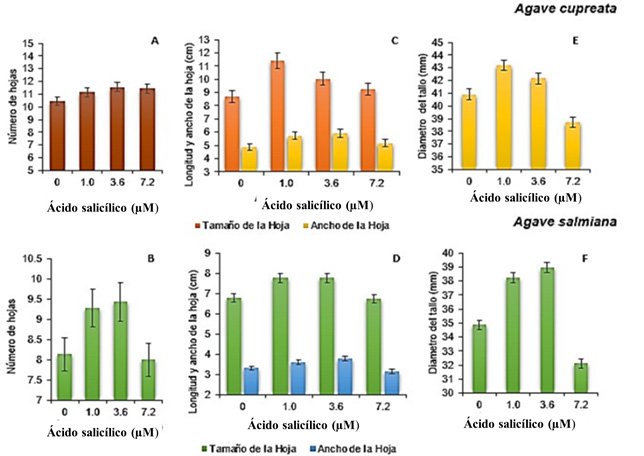
In Mexico, the Agave genus is of socioeconomic, agroecological, and cultural importance due to its multiple uses, including the production of beverages such as tequila, mezcal, bacanora, and pulque. The quantity and type of sugars contained in the stem determine the quality and quantity of the alcohol produced. However, the agave reproductive cycle is very long (7-35 years). To accelerate the growth of these plants, it is important to seek efficient and ecological strategies. In this sense, salicylic acid (SA) is a growth-regulating hormone, and its application could enhance agave metabolism. The objective of this word was evaluate the effect of different SA concentrations on the increase in reducing sugars and biomass in Agave cupreata and A. salmiana plants grown in a semi-hydroponic system under greenhouse conditions. Plants were evaluated under identical nutritional conditions but treated with different concentrations of SA. The sampled plants were sectioned into three parts (leaves, stem and root), and the effect of AS on morphological characteristics, the amount of dry organic matter and quantification of reducing sugars was evaluated. AS had a differential effect on the two agave species evaluated. In terms of dry organic matter, a significant increase was observed in the stem when 1 µMol/L was applied to Agave cupreata, while in Agave salmiana the best treatment showed a high concentration of organic dry matter in the root when 3.6 µMol/L of AS was applied. A significant increase in reducing sugars (76 g/100 g) occurred in the stem and leaf of Agave salmiana when 1 µMol/L of AS was applied, with the leaf showing the greatest increase in biomass in both agave species. Growth, biomass, and the concentration of reducing sugars decreased as a negative effect of applying AS at a concentration of 72 µMol/L. Growing agave plants under greenhouse conditions in semi-hydroponic systems is a strategy that can help agave plants boost their growth rate and increase their biomass, which translates into faster production of reducing sugars by making photosynthesis more efficient. Furthermore, irrigation water is saved, making it an environmentally friendly strategy that helps reduce the impact of global warming. Finally, this knowledge can be extrapolated to plants with CAM metabolism. Agave plants increase their biomass and reduce sugar content at low concentrations of salicylic acid, while at high concentrations it can produce an inhibitory effect.
References
Anchondo-Aguilar, A., Núñez-Barrios, A., Ruiz-Anchondo, T., Martínez-Tellez, J., Vergara-Yoisura, S., & Larqué-Saavedra, A. (2011). Efect of salicylic acid in bioproductivity of strawberry(Fragaria ananassa) cv Aromosa. In Revista Mexicana de Ciencias Agrícolas (Vol. 2).
Arrazola-Cárdenas, L., García-Nava, J. R., Robledo-Paz, A., Ybarra-Moncada, M. C., & Muratalla-Lúa, A. (2020). Sustratos y dosis de fertirrigación en la acumulación de azúcares totales y el crecimiento de Agave salmiana (asparagaceae). Polibotánica, 0(50). https://doi.org/10.18387/polibotanica.50.8
Bautista-Justo, M., García Oropeza, L., Salcedo Hernández, R., & Parra Negrete, L. A. (2001). Azucar en Agave. Acta universitaria, 11(AZUCARES EN AGAVES (Agaves tequilana Weber) CULTIVADOS EN EL ESTADO DE GUANAJUATO), 33–38. http://www.realyc.org.artticulo.oa?d=41611105
González-Díaz, R. L., Rodríguez-Gómez, F., & Cortés-Romero, C. (2020). Fructan exohydrolases y its importance in the metabolism of fructans in agave tequilana weber var. Azul. Revista Colombiana de Quimica, 49(3), 3–12. https://doi.org/10.15446/rcq.v49n3.84882
Gutiérrez-Coronado, M. A., Trejo-López, C., & Larqué-Saavedra, A. (1998). Effects of salicylic acid on the growth of roots and shoots in soybean. Plant Physiology and Biochemistry, 36(8), 563–565. https://doi.org/10.1016/S0981-9428(98)80003-X
Hayat, S., & Ahmad, A. (2007). SALICYLIC ACID A Plant Hormone.
Khodary, S. E. A. (2004). Effect of Salicylic Acid on the Growth, Photosynthesis and Carbohydrate Metabolism in Salt Stressed Maize Plants. In INTERNATIONAL JOURNAL OF AGRICULTURE & BIOLOGY. http://www.ijab.org
Khoshbakht, D., & Asgharei, M. R. (2015). Influence of foliar-applied salicylic acid on growth, gas-exchange characteristics, and chlorophyll fluorescence in citrus under saline conditions. Photosynthetica, 53(3), 410–418. https://doi.org/10.1007/s11099-015-0109-2
Larqué-Saavedra, A., & Martin-Mex, R. (2007). Chapter 2 Effects of Salicytic Acid on the Bioproductivity of plants.
Lopez, M. G., Mancilla-Margalli, N. A., & Mendoza-Diaz, G. (2003). Molecular Structures of Fructans from Agave tequilana Weber var. azul. Journal of Agricultural and Food Chemistry, 51(27), 7835–7840. https://doi.org/10.1021/jf030383v
Martin-Mex, R., Nexticapan-Garcéz, Á., Herrera-Tuz, R., Vergara-Yoisura, S., & Larqué-Saavedra, A. (2012). Positive effect of salicylic acid application on productivity of papaya (Carica papaya). In Revista Mexicana de Ciencias Agrícolas (Vol. 3).
Martín-Mex, R., Nexticapan-Garcez, A., & Larqué-Saavedra, A. (2013). Potential Benefits of Salicylic Acid in Food Production. In SALICYLIC ACID (pp. 299–313). Springer Netherlands. https://doi.org/10.1007/978-94-007-6428-6_13
Medallo-Mojica, Erika., & López-Pérez, M. G. (2013). Analisis comparativo entre jarabe de agave azul (Agave tequilana Weber var. azul) y otros jarabes naturales. Agrociencia, 47(Analisis comparativo entres jarabe de agave azul () Agave tequilana Weber var. azul) y otros jarabes naturales), 233–244. www.redalcyc.org/articulo.oa?id=30226978003
Mendoza-García, J. A. (2007). Los agaves de México. https://www.researchgate.net/publication/26549731
Rodríguez-García, M. F., Huerta-Espino, J., Villaseñor-Mir, H. E., Rivas-Valencia, P., González-González, M., Hortelano-Santa Rosa, R., Robles-Yerena, L., & Aranda-Ocampo, S. (2020). Chemical treatment to wheat seed to reduce the incidence of bacteria. Revista Mexicana de Fitopatología, Mexican Journal of Phytopathology, 38(2). https://doi.org/10.18781/r.mex.fit.2001-5
Sánchez-Mendoza, S., & Bautista-Cruz, A. (2022). Efecto de fertilizantes de liberación lenta y fitohormonas en el crecimiento de Agave angustifolia Haw. Entreciencias: Diálogos En La Sociedad Del Conocimiento, 10(24). https://doi.org/10.22201/enesl.20078064e.2022.24.82738
Steiner, A. A. (1961). A Uiniversal Method for Preparing Nutrient Solicions of a certain Desired Composition.
Downloads
Published
License
Copyright (c) 2026 POLIBOTANICA

This work is licensed under a Creative Commons Attribution-NonCommercial-ShareAlike 4.0 International License.

Polibotánica by Departamento de Botánica de la Escuela Nacional de Ciencias Biológicas del Instituto Politécnico Nacional se distribuye bajo una Licencia Creative Commons Atribución-NoComercial-CompartirIgual 4.0 Internacional.