Cryopreservation of encapsulated floral explants of cacao (Theobroma cacao l.) by dehydration and vitrification
DOI:
https://doi.org/10.18387/polibotanica.60.16Keywords:
in vitro, encapsulation-dehydration, encapsulation-vitrification, PVS solutions.Abstract
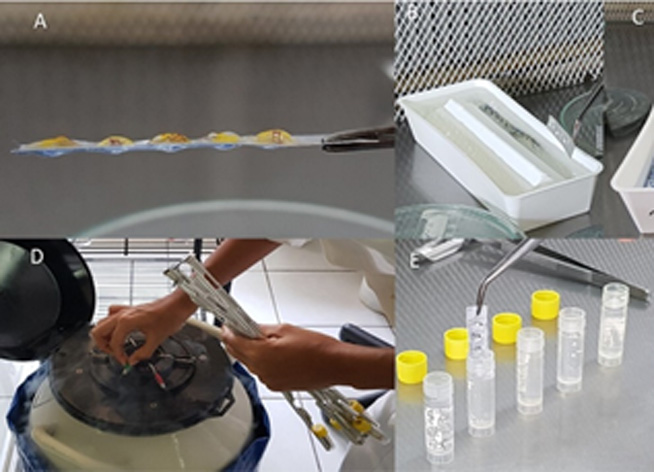
The application of somatic embryogenesis in cacao (Theobroma cacao L.), which depends on floral tissues, faces limitations due to the restricted availability of flowers. The cryopreservation of floral tissues emerges as a potential strategy for conserving cacao diversity, especially considering that no studies have yet reported the use of floral explants for this purpose. This study aimed to evaluate the influence of genotype, floral explant type, and variants of the cryogenic techniques encapsulation-vitrification and encapsulation-dehydration on the survival of cacao floral explants subjected to cryopreservation. Two experiments were designed and implemented as in vitro conservation strategies, evaluating petals, staminodes, and anthers from two experimental genotypes (F9P6 and F19P3). In the first experiment, the encapsulation-dehydration technique was applied; explants were cultured in DKW medium for one day and then subjected to two dehydration methods (laminar airflow and silica gel) and two dehydration durations (3 and 5 hours). In the second experiment, the encapsulation-vitrification technique was used; explants of both genotypes were precultured in DKW medium under two sucrose conditions (0.00 M and 0.75 M) for five days and treated with two cryoprotectants (PVS2 and PVS4). In both experiments, the following variables were evaluated: tissue necrosis, increase in weight or volume, callus formation, and viability. After 35 days, petal explants showed the highest viability. In encapsulation-dehydration, petals of genotype F9P6 achieved 100% viability after 5 h with silica gel, while F19P3 reached the same viability after 5 h under laminar airflow or 3 h with silica gel. In encapsulation-vitrification, petals of F9P6 reached 100% viability without sucrose using either cryoprotectant, and with 0.75 M sucrose using PVS4. In the case of F19P3, 100% viability was obtained with PVS4 without sucrose. No increase in volume or callus formation was observed in cryopreserved explants.
References
Abdelnour, A. (1999). Crioconservación de plantas, estado actual de la investigación en Costa Rica. Agronomia Costarricense, 23(2), 205–214. https://link.gale.com/apps/doc/A109220326/IFME?u=anon~873386c4&sid=googleScholar&xid=7d25c7cf
Adu-Gyamfi, R., & Wetten, A. (2012). Cryopreservation of cocoa (Theobroma cacao L.) somatic embryos by vitrification. CryoLetters, 33(6), 494–505.
Adu-Gyamfi, R., Wetten, A., & Marcelino Rodríguez López, C. (2016). Effect of Cryopreservation and Post-Cryopreservation Somatic Embryogenesis on the Epigenetic Fidelity of Cocoa (Theobroma cacao L.). PLOS ONE, 11(7), e0158857. https://doi.org/10.1371/journal.pone.0158857
Aguirre, M., J. F Alonso-B., Iracheta D., Grajales S., Avendaño B., Olivera de los Stos., López-Navarrete., Zamarripa C., Gallardo M., & López G. (2010). Tecnologías para la producción de cacao. Instituto Nacional de Investigaciones Forestales, Agrícolas y Pecuarias. Campo Experimental Rosario Izapa.
Avendaño-Arrazate, C. H., Guillén-Díaz, S., & Hernández-Gómez, E. (2018). “Regalo de Dios”: Clon de cacao (Theobroma cacao L.) tolerante a Moniliophthora roreri Cif & Par, para la renovación de las zonas cacaoteras de México. Agroproductividad, 11(9), 173–176.
Azofeifa, Á. (2009). Problemas de oxidación y oscurecimiento de explantes cultivados in vitro. Agronomía Mesoamericana, 20(1), 153–175.
Castañeda, P. R. (1990). Bioestadística aplicada. Trillas. https://books.google.com.mx/books?id=RfVBPgAACAAJ
Chalker-Scott, L., & Fuchigami, L. H. (1989). The role of phenolic compounds in plant stress responses. Low Temperature Stress Physiology in Crops, 68–76.
Cisne, C. J. D. (1992). Criopreservación de embriones cigóticos y somáticos de cacao. [Tesis de maestría]. Centro Agronómico Tropical de Investigación y Enseñanza.
Driver, J., & Kuniyuki, A. H. (1984). In vitro propagation of Paradox Walnut root stock. HortScience: A Publication of the American Society for Horticultural Science, 18, 506–509. https://doi.org/https://doi.org/10.21273/HORTSCI.19.4.507
Engelmann, F., & González-Arnao, M. T. (2013). 3 Introducción a la conservación ex situ de los recursos genéticos vegetales. In M. T. González-Arnao & F. Engelmann (Eds.), Crioconservación de plantas en américa latina y el caribe (pp. 25–35). IICA.
Fang, J.-Y., Wetten, A., & Hadley, P. (2004). Cryopreservation of cocoa (Theobroma cacao L.) somatic embryos for long-term germplasm storage. Plant Science, 166(3), 669–675. https://doi.org/https://doi.org/10.1016/j.plantsci.2003.11.002
Fuentes, B. A. (2014). Respuesta del callo embriogénico de cacao a modificaciones de la consistencia y componentes del medio de cultivo [Tesis de licenciatura]. Universidad Autónoma de Chiapas.
Gowthami, R., Agrawal, A., Chander, S., Pandey, R., Sharma, N., Gupta, S., Srivastava, V., Malhotra, E. V., Bansal, S., Malik, S. K., Mahendru-Singh, A., & Singh, G. P. (2025). In vitro Genebank of India for safe conservation of horticultural plant diversity: four decades of milestones. 3 Biotech, 15(11), 1–26. https://doi.org/10.1007/s13205-024-04177-2
Guzmán, T. B. (2010). Efecto del tipo de explante, estado y componentes del medio de cultivo en el origen y formación in vitro de tejido embrionario de cacao (Theobroma cacao L.) [Tesis de licenciatura]. Universidad Autónoma de Chiapas.
Hernández-Gómez, E., Hernández-Morales, J., Avendaño-Arrazate, C. H., López-Guillen, G., Garrido-Ramírez, E. R., Romero-Nápoles, J., & Nava-Díaz, C. (2015). Factores socieconómicos y parasitológicos que limitan la producción del cacao en Chiapas, México. Revista Mexicana de Fitopatología, 33(2), 232–246. http://www.scielo.org.mx/scielo.php?script=sci_arttext&pid=S0185-33092015000200232&lng=es&tlng=es.
Iracheta-Donjuan, L., Cruz-López, L. A., López-Gómez, P., Avendaño-Arrazate, C. H., & Ortíz-Curiel, S. (2019). 2iP y brasinosteroides promueven la inducción de la embriogénesis somática en Theobroma cacao L. Agro Productividad, 12(1), 65–70. https://doi.org/10.32854/agrop.v0i0.1340
Iracheta-Donjuan, L., López-Gómez, P., & Avendaño-Arrazate, C. (2017). Variabilidad de la capacidad morfogénica in vitro de híbridos interclonales de Theobroma cacao L. In E. de J. Pérez Álvarez & M. B. Arévalo Dorry (Eds.), Congreso Mesoamericano de Investigación UNACH (pp. 1404–1409). Universidad Autónoma de Chiapas. https://dgip.unach.mx/images/CMIU/PDF/CMIU-2017.pdf
Marassi, M. A., Scocchi, A., & Gonzalez, A. M. (2006). Plant regeneration from rice anthers cryopreserved by an encapsulation/dehydration technique. In Vitro Cellular & Developmental Biology - Plant, 42(1), 31–36. https://doi.org/10.1079/IVP2005746
Matsumoto, T., & Niino, T. (2017). Development of vitrification method. In T. Niino, T. Matsumoto, S. Yamamoto, S. Mki, D. Tanaka, & F. Engelmann (Eds.), Manual of Cryopreservation Methods using Cryo-plate (pp. 8–15). PTCCryo Group.
Mosa, K. A., Ahmed, A. E., Hazem, Y., Kanawati, I. S., Abdullah, A., Hernandez-Sori, L., Ali, M. A., & Vendrame, W. (2023). Insights into cryopreservation, recovery and genetic stability of medicinal plant tissues. Fitoterapia, 169, 105555. https://doi.org/10.1016/j.fitote.2023.105555
Orozco de León, W. V. (2008). Establecimiento in vitro e inducción de la organogénesis en clones de cacao resistentes a la moniliasis [Tesis de licenciatura]. Universidad autónoma de Chiapas.
Osorio Saenz, A., Mascorro Gallardo, J. O., Rodríguez de la O, J. L., Melchor López, C., & González Arnao, M. T. (2011). Crioconservación de ápices de crisantemo (Dendranthema grandiflorum Kitam) por encapsulación-deshidratación y por vitrificación. Revista Chapingo Serie Horticultura, XVII, 33–43.
Pence, V. C. (1991). Cryopreservation of immature embryos of Theobroma cacao. Plant Cell Reports, 10, 144–191.
Pineda-Aguilar, J., Iracheta-Donjuan, L., Avendaño-Arrazate, C. H., & López-Gómez P. (2016). Efecto del precultivo con elicitores y crioprotectores en la reactivación de callos de Theobroma cacao L. Memorias de XI Congreso de Biotecnología.
Poobathy, R., Xavier, R., Sinniah, U. R., & Subramaniam, S. (2013). Molecular stability of protocorm-like bodies of Dendrobium sonia-28 after encapsulation- dehydration and vitrification. Australian Journal of Crop Science, 7, 189–195.
Robles, G. K. K. (2015). Efecto de la vernalización y reguladores de crecimiento en la inducción de callo haploide de Theobroma cacao L. [Tesis de licenciatura]. Universidad autónoma de Chiapas.
Sakai, A., & Engelmann, F. (2007). Vitrification, Encapsulation-Vitrification and Droplet-Vitrification: A review. CryoLetters, 28(3), 151–172.
Sakai, A., Kobayashi, S., & Oiyama, I. (1991). Cryopreservation of nucellar cells of navel orange (Citrus sinensis Osb.) by a simple freezing method. Plant Science, 74(2), 243–248. https://doi.org/https://doi.org/10.1016/0168-9452(91)90052-A
Sánchez-Chiang, N., & Jiménez, V. M. (2010). Técnicas de conservación in vitro para el establecimiento de bancos de germoplasma en cultivos tropicales. Agronomía Mesoamericana, 21(1), 193–205.
Silva Pupo, J. J., Montes Cruz, S., Acosta Pompa, L., Arias, E., & García Alcántara, A. (2005). Embriogénesis somática: una alternativa para la propagación, mejoramiento y conservación de germoplasma en cacao. Cuadernos de Biodiversidad, 16, 9–12. https://doi.org/10.14198/cdbio.2005.16.02
Solís Bonilla, J. L., Zamarripa Colmenero, A., Pecina Quintero, V., Garrido Ramírez, E., & Hernández Gómez, E. (2015). Evaluación agronómica de híbridos de cacao (Theobroma cacao L.) para selección de alto rendimiento y resistencia en campo a moniliasis. Revista Mexicana de Ciencias Agrícolas, 6 (1), 71–82.
Suriano, de P. Y. (2009). Introducción de Embriogénesis somática en genotipos de cacao con diferente grado de resistencia a la moniliasis [Tesis para ingeniero biotecnólogo]. Universidad Autónoma de Chiapas.
Tirado, P. B. (2014). Efecto del medio de cultivo y tamaño del explante sobre la embriogénesis secundaria en Theobroma cacao L. [Tesis de licenciatura]. Universidad autónoma de Chiapas.
Zhang, J.-M., Lu, X.-X., Xin, X., Yin, G.-K., He, J.-J., Huang, B., Jiang, D., & Chen, X.-L. (2017). Cryopreservation of Citrus anthers in the National Crop Genebank of China. In Vitro Cellular & Developmental Biology - Plant, 53(4), 318–327. https://doi.org/10.1007/s11627-017-9848-z
Downloads
Published
License
Copyright (c) 2026 POLIBOTANICA

This work is licensed under a Creative Commons Attribution-NonCommercial-ShareAlike 4.0 International License.

Polibotánica by Departamento de Botánica de la Escuela Nacional de Ciencias Biológicas del Instituto Politécnico Nacional se distribuye bajo una Licencia Creative Commons Atribución-NoComercial-CompartirIgual 4.0 Internacional.