Effect of arbuscular mycorrhizal fungi on the survival and growth of Dalbergia congestiflora plants propagated in vitro and from seed under greenhouse conditions
DOI:
https://doi.org/10.18387/polibotanica.60.15Keywords:
Campincerán, calidad de planta, propagación in vitro, propagación por semillaAbstract
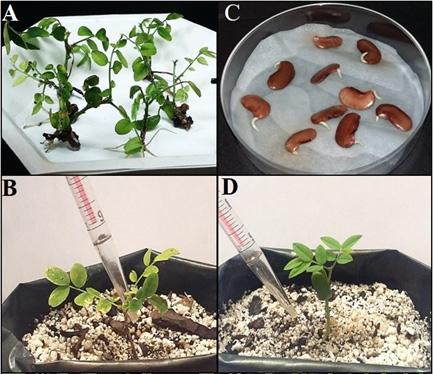
Tree species with a threatened status face propagation difficulties, and those plants that manage to survive require specific strategies to counteract their reduced growth and development. Among the most commonly used strategies are fertilization and the addition of beneficial microorganisms, such as endomycorrhizal fungi. The species Dalbergia congestiflora Pittier (Fabaceae) is threatened and has survival difficulties both in greenhouse and field cultivation due to its poor plant quality. The specific objective of this research is to determine the effect of adding endomycorrhizae to D. congestiflora plants, both micropropagated (asexual propagation) and seed-propagated (sexual propagation), on the growth and development of plants grown in a greenhouse, in order to ensure high survival rates. The micropropagated plants were developed by induction and multiplication of shoots in vitro from calluses, which were then rooted to regenerate plantlets. These plantlets were successfully acclimatized and cultivated in a greenhouse. On the other hand, D. congestiflora seeds were germinated in Petri dishes with moist filter paper, and once seedlings developed, these were grown in a greenhouse. Both types of plants were inoculated with commercial endomycorrhizae at three spore concentrations (80, 128, and 176 spores per plant) and a control (0 spores). Under greenhouse conditions, growth parameters such as survival, plant height, stem diameter, number of leaves, and canopy cover were evaluated over 180 days. Survival of micropropagated and seed-grown plants was higher in the treatments inoculated with endomycorrhizae. Micropropagated plants without inoculation showed no significant differences in height, stem diameter, or number of leaves compared to the inoculated treatments. However, in seed-propagated plants, greater values for height and number of leaflets were observed in the treatment with 176 spores per plant compared to the other treatments. The difference was most significant at 180 days post-inoculation. Mycorrhizal D. congestiflora plants, from both propagation systems, showed the highest percentages of survival and plant height.
References
Aguirre-Medina, J. F., Moroyoqui-Ovilla, D. M., Mendoza-López, A., Cadena-Iñiguez, J., Avendaño-Arrazate, C. H., & Aguirre-Cadena, J. F. (2011). Hongo endomicorrízico y bacteria fijadora de nitrógeno inoculadas a Coffea arabica en vivero. Agronomía Mesoamericana, 22(1), 71–80. https://www.redalyc.org/articulo.oa?id=43721202009
Ancona, S., De Mastro, G., Jenderek, M. M., & Ruta, C. (2021). Micropropagation supports reintroduction of an apulian artichoke landrace in sustainable cropping systems. Agronomy, 11(6). https://doi.org/10.3390/agronomy11061169
Barboza Nogueira, F. C., Medeiros Filho, S., Baldoni, R. N., & Sampaio e Silva, T. A. (2014). Is the seed dispersal related to spatial pattern of individuals in populations? The case of Dalbergia cearensis. American Journal of Plant Sciences, 05(20), 2997–3004. https://doi.org/10.4236/ajps.2014.520316
Bernaola-Paucar, R. M., Ruiz-Blandon, B., Salcedo-Pérez, E., & Zapata-Hernández, I. (2022). Nursery management factors that influence growth and survival of Pinus douglasiana in Mexico. Bosque, 43(2), 101–115. https://doi.org/10.4067/S0717-92002022000200101
Bhardwaj, A. K., Chandra, K. K., & Kumar, R. (2023). Water stress changes on AMF colonization, stomatal conductance and photosynthesis of Dalbergia sissoo seedlings grown in entisol soil under nursery condition. Forest Science and Technology, 19(1), 47–58. https://doi.org/10.1080/21580103.2023.2167873
Bisht, R., Chaturvedi, S., Srivastava, R., Sharma, A. K., & Johri, B. N. (2009). Effect of arbuscular mycorrhizal fungi, Pseudomonas fluorescens and Rhizobium leguminosarum on the growth and nutrient status of Dalbergia sissoo Roxb. Tropical Ecology, 50(2), 231–242. https://www.researchgate.net/publication/255454806
Casillas-Sánchez J.I. (2014). Propagación de Tilia americana var. Mexicana y Dalbergia congestiflora. (Tesis inédita de Maestría). Universidad Michoacana de San Nicolás de Hidalgo, Morelia, México. http://bibliotecavirtual.dgb.umich.mx:8083/jspui/bitstream/DGB_UMICH/208/1/FITECMA-M-2015-1349.pdf
da Silva, A. R., de Melo, N. F., & Yano-Melo, A. M. (2017). Acclimatization of micropropagated plants of Etlingera elatior (Jack) R. M. Sm. inoculated with arbuscular mycorrhizal fungi. South African Journal of Botany, 113, 164–169. https://doi.org/10.1016/j.sajb.2017.08.014
El Haddadi, R., El Mekkaoui, A., Zouahri, A., Ouazzani Touhami, A., & Douira, A. (2022). Effect of growing media on morpho-physiological quality attributes of Tetraclinis articulata seedlings. Forest Science and Technology, 18(3), 108–117. https://doi.org/10.1080/21580103.2022.2104936
El Kinany, S., Achbani, E., Faggroud, M., Ouahmane, L., El Hilali, R., Haggoud, A., & Bouamri, R. (2019). Effect of organic fertilizer and commercial arbuscular mycorrhizal fungi on the growth of micropropagated date palm cv. Feggouss. Journal of the Saudi Society of Agricultural Sciences, 18(4), 411–417. https://doi.org/10.1016/j.jssas.2018.01.004
García, E. G., & Di Stéfano, J. F. (2000). Temperatura y germinación de las semillas de Dalbergia retusa (Papilionaceae), árbol en peligro de extinción. Revista de Biología Tropical, 48(1), 43–45. https://doi.org/10.15517/rbt.v48i1.18148
Gómez-Falcón, N., Sáenz-Carbonell, L. A., Andrade-Torres, A., Lara-Pérez, L. A., Narváez, M., & Oropeza, C. (2023). Arbuscular mycorrhizal fungi increase the survival and growth of micropropagated coconut (Cocos nucifera L.) plantlets. In Vitro Cellular and Developmental Biology - Plant, 59(3), 401–412. https://doi.org/10.1007/s11627-023-10345-5
Hernández García, A., Salgado Garciglia, R., & Ambriz Parra, E. (2016). Propagation of Dalbergia congestiflora Pittier (Fabaceae) by steam cuttings: Effect of IBA concentration and position of cuttings on shoots. Nova Scientia, 8(17), 87–96. http://www.scielo.org.mx/scielo.php?script=sci_arttext&pid=S2007-07052016000200087&lng=es&tlng=es.
Hernández-García, A., Ambriz-Parra, E., López-Albarrán, P., León, J. C. De, & Salgado-Garciglia, R. (2021). In vitro propagation from axillary buds of the endangered tree Dalbergia congestiflora Pittier (Fabaceae). Plant Biotechnology, 38(4), 409–414. https://doi.org/10.5511/PLANTBIOTECHNOLOGY.21.0901A
López-Barreto, C. A. (2015). Evaluación de sobrevivencia e incremento de seis especies forestales maderables en plantaciones de la finca Eco forestal, San Juan del Sur, Rivas. (Tesis inédita de Doctorado). Universidad Nacional Agraria. https://repositorio.una.edu.ni/3240/1/tnk10l864v.pdf
Márquez-Torres, J. F., & Martinez-Garza, C. (2022). Survival of 12 native tree species in restoration plantings in the dry forest. Botanical Sciences, 100(2), 314-330. https://doi.org/10.17129/botsci.2878
Mežaka, I., Kļaviņa, D., Kaļāne, L., & Kronberga, A. (2023). Large-Scale in vitro propagation and ex vitro adaptation of the endangered medicinal plant Eryngium maritimum L. Horticulturae, 9(2), 271-275. https://doi.org/10.3390/horticulturae9020271
Mirdhe, R. M., & Lakshman, H. C. (2009). Synergistic effect of arbuscular mycorrhizal fungi and Rhizobium inoculation on Dalbergia sissoo Roxb in unsterile soil. Nat. Environ. Pollut. Technol, 8(4), 781–784. https://www.neptjournal.com/upload-images/NL-1-28-(28)-B-1389.pdf
Mortier, E., Jacquiod, S., Jouve, L., Martin-Laurent, F., Recorbet, G., & Lamotte, O. (2023). Micropropagated walnut dependency on phosphate fertilization and arbuscular mycorrhiza for growth, nutrition and quality differ between rootstocks both after acclimatization and post-acclimatization. Scientia Horticulturae, 318. https://doi.org/10.1016/j.scienta.2023.112081
Murashige, T., & Skoog, F. (1962). A revised medium for rapid growth and bio assays with tobacco tissue cultures. Physiologia Plantarum, 15(3), 473-497. https://doi.org/10.1111/j.1399-3054.1962.tb08052.x
Niranjan, R., Mohan, V., & Rao, V. M. (2007). Effect of indole acetic acid on the synergistic interactions of Bradyrhizobium and Glomus fasciculatum on growth, nodulation, and nitrogen fixation of Dalbergia sissoo Roxb. Arid Land Research and Management, 21(4), 329–342. https://doi.org/10.1080/15324980701603573
Paz, M. P., Trejo, D. A. R., Morales, A. V., & De la Rosa, M. A. M. B. (2023). Fertilization, plant quality and field survival of Pinus spp. in Ixtlán de Juárez, state of Oaxaca. Revista Mexicana de Ciencias Forestales, 14(76), 71–92. https://doi.org/10.29298/rmcf.v14i76.1324
Pogorzelec, M., Parzymies, M., Banach-Albińska, B., Serafin, A., & Klemedtsson, L. (2020). Experimental reintroduction of the boreal species Salix lapponum L. to refuges at the southern limit of its range-short term results. Boreal Environment Research, 25(1–6), 1. https://doi.org/10.5586/aa.2014.043
Ruiz, S. S., Ruíz, J. Á. P., Aispuro, E. S., Simental, J. A. C., & Aispuro, R. E. M. (2021). Survival and growth of Pinus engelmannii Carr. In a reforestation from mycorrhization and fertilization. Revista Mexicana de Ciencias Forestales, 12(64). https://doi.org/10.29298/rmcf.v12i64.847
Salama, A., Shukla, M. R., Popova, E., Fisk, N. S., Jones, M. P., & Saxena, P. K. (2017). In vitro propagation and reintroduction of golden paintbrush (Castilleja levisecta), a critically imperilled plant species. Canadian Journal of Plant Science, 98(3), 762–770. https://doi.org/10.1139/cjps-2017-0207
Saravanan, T. S., Rajendran, K., Uma, M., & Chezhian, P. (2013). Effects of bioinoculants on quality seedling production and nutrient uptake of Casuarina equisetifolia forst. Grown in decomposed coir pith. In Microbiological Research in Agroecosystem Management (pp. 141–154). Springer India. https://doi.org/10.1007/978-81-322-1087-0_10
Sosa Rodríguez, T., Sánchez Nieves, J., Melgarejo, L. U. Z., & Caro, M. (2009). Efecto de la inoculación con Hongos formadores de micorrizas arbusculares sobre plántulas de Caucho. Acta Biologica Colombiana, 14(3), 31–46. https://repositorio.unal.edu.co/handle/unal/23047
Wang, M., Cheng, Z., Li, G., Wang, J., & Uscola, M. (2023). The tradeoff strategy between growth and survival in Quercus variabilis seedlings: determining the most limiting resource in the field drive shoot dieback. Forestry, 96(4), 575–587. https://doi.org/10.1093/forestry/cpac062
Watkinson, A. D., Naeth, M. A., & Pruss, S. D. (2022). Nutrient loading Artemisia cana seedlings in greenhouse increases nitrogen tissue content and post-outplanting survival. Restoration Ecology, 30. https://doi.org/10.1111/rec.13590
Downloads
Published
Issue
Section
Categories
License
Copyright (c) 2026 POLIBOTANICA

This work is licensed under a Creative Commons Attribution-NonCommercial-ShareAlike 4.0 International License.

Polibotánica by Departamento de Botánica de la Escuela Nacional de Ciencias Biológicas del Instituto Politécnico Nacional se distribuye bajo una Licencia Creative Commons Atribución-NoComercial-CompartirIgual 4.0 Internacional.