Dinámica fenológica mensual de especies de bosque mixto
DOI:
https://doi.org/10.18387/polibotanica.60.14Palabras clave:
Fenología; bosques mixtos; multiespecie; Pinus; Quercus; Juniperus; Arbutus.Resumen
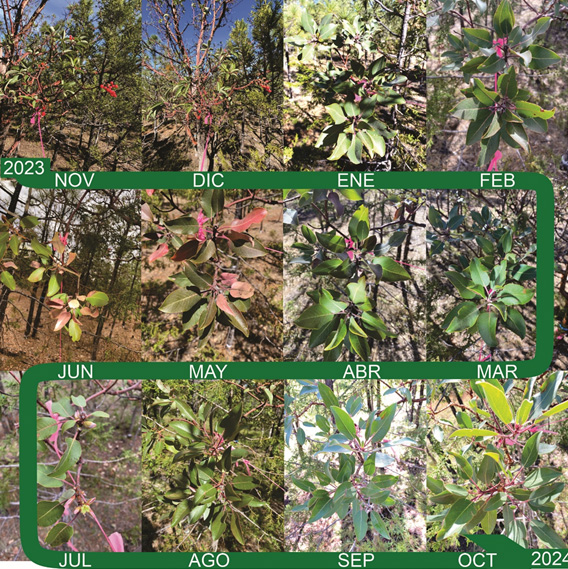
Los ecosistemas forestales están modificando su fenología como consecuencia de los frecuentes y exacerbados episodios de sequía. Los bosques mixtos han sido considerados estratégicos para lidiar con el cambio climático, por lo que conocer sus procesos fenológicos contribuye a generar información útil para anticipar cambios en la composición de especies ante el calentamiento global. En este estudio describimos mensualmente a lo largo de un año las fenofases de cinco especies coexistentes en un bosque mixto, en una región del norte de México altamente diversa pero susceptible a la sequía. Encontramos diversas fenofases entre coníferas y latifoliadas, comprendidas en reposo, caída de hojas, desarrollo de yemas, elongación del follaje y formación y crecimiento de órganos reproductivos, con sus diferencias temporales entre ellas. La especie Pinus engelmannii, tuvo el inicio más temprano de sus fenofases, mientras que Arbutus bicolor fue la más tardía en algunas fases. La mayor duración se presentó en Juniperus deppeana y la de menor fue Arbutus bicolor. Aunque se requieren más datos complementarios de clima, así como de acortar la periodicidad de los muestreos, nuestros resultados se interpretan como respuestas a mecanismos fisiológicos que presentan las especies como estrategias de respuesta ante el entorno. Si bien, los resultados no son del todo concluyentes, constituyen una base esencial para continuar el monitoreo y potenciar el entendimiento de la fenología en los bosques mixtos de cara a los escenarios de sequía pronosticada.
Referencias
Adams, R. P., Schwarzbach, A. E., Nguyen, S., & Morris, J. A. (2007). Geographic variation in Juniperus deppeana. Phytologia, 89(2), 132–150.
Alcantara Cortes, J. S., Acero-Godoy, J., Alcántara-Cortés, J. D., & Sánchez-Mora, R. M. (2019). Principales reguladores hormonales y sus interacciones en el crecimiento vegetal. NOVA, 17(32), 109–129.
Allen, C. D., Breshears, D. D., & McDowell, N. G. (2015). On underestimation of global vulnerability to tree mortality and forest die-off from hotter drought in the Anthropocene. Ecosphere, 6(8), 1–55. https://doi.org/10.1890/ES15-00203.1
Anderegg, W. R. L., Trugman, A. T., Badgley, G., Anderson, C. M., Bartuska, A., Ciais, P., Cullenward, D., Field, C. B., Freeman, J., Goetz, S. J., Hicke, J. A., Huntzinger, D., Jackson, R. B., Nickerson, J., Pacala, S., & Randerson, J. T. (2020). Climate-driven risks to the climate mitigation potential of forests. Science, 368(6497), eaaz7005. https://doi.org/10.1126/science.aaz7005
Brown, T. B., Hultine, K. R., Steltzer, H., Denny, E. G., Denslow, M. W., Granados, J., Henderson, S., Moore, D., Nagai, S., SanClements, M., Sánchez‐Azofeifa, A., Sonnentag, O., Tazik, D., & Richardson, A. D. (2016). Using phenocams to monitor our changing Earth: toward a global phenocam network. Frontiers in Ecology and the Environment, 14(2), 84–93. https://doi.org/10.1002/fee.1222
Cleland, E. E., Chuine, I., Menzel, A., Mooney, H. A., & Schwartz, M. D. (2007). Shifting plant phenology in response to global change. Trends in Ecology and Evolution, 22(7), 357–365. https://doi.org/10.1016/j.tree.2007.04.003
Cleland, R. E. (2010). Auxin and Cell Elongation. En P. J. Davies (Ed.), Plant Hormones: Biosynthesis, Signal Transduction, Action! (3a ed., pp. 204–220). Springer Dordrecht. https://doi.org/10.1007/978-1-4020-2686-7_10
Delpierre, N., Vitasse, Y., Chuine, I., Guillemot, J., Bazot, S., Rutishauser, T., & Rathgeber, C. B. K. (2016). Temperate and boreal forest tree phenology: from organ-scale processes to terrestrial ecosystem models. Annals of Forest Science, 73, 5–25. https://doi.org/10.1007/s13595-015-0477-6
Duputié, A., Rutschmann, A., Ronce, O., & Chuine, I. (2015). Phenological plasticity will not help all species adapt to climate change. Global Change Biology, 21(8), 3062–3073. https://doi.org/10.1111/gcb.12914
Felipe-Lucia, M. R., Soliveres, S., Penone, C., Manning, P., van der Plas, F., Boch, S., Prati, D., Ammer, C., Schall, P., Gossner, M. M., Bauhus, J., Buscot, F., Blaser, S., Blüthgen, N., de Frutos, A., Ehbrecht, M., Frank, K., Goldmann, K., Hänsel, F., … Allan, E. (2018). Multiple forest attributes underpin the supply of multiple ecosystem services. Nature Communications, 9, 4839. https://doi.org/10.1038/s41467-018-07082-4
Flores, S., Forister, M. L., Sulbaran, H., Díaz, R., & Dyer, L. A. (2023). Extreme drought disrupts plant phenology: Insights from 35 years of cloud forest data in Venezuela. Ecology, 104(5), e4012. https://doi.org/10.1002/ecy.4012
Fritts, H. C. (1976). Tree Rings and Climate. Academic Press. https://doi.org/10.1016/B978-0-12-268450-0.X5001-0
García-Pérez, J. L., Aldrete, A., López-Upton, J., Vargas-Hernández, J. J., & Prieto-Ruíz, J. Á. (2015). Efecto de la condición ambiental y la fertilización en el preacondicionamiento de Pinus engelmannii Carr. en vivero. Revista Fitotecnia Mexicana, 38(3), 297–304.
González-Elizondo, M. S., González-Elizondo, M., & Sørensen, P. D. (2012). Arbutus bicolor (Ericaceae, Arbuteae), a new species from Mexico. Acta Botanica Mexicana, 99, 55–72. https://doi.org/10.21829/abm99.2012.19
González-Elizondo, M. S., González-Elizondo, M., Tena-Flores, J. A., Ruacho-González, L., & López-Enríquez, I. L. (2012). Vegetación de la Sierra Madre Occidental, México: Una síntesis. Acta Botanica Mexicana, 100, 351–403. https://doi.org/10.21829/abm100.2012.40
Gray, R. E. J., & Ewers, R. M. (2021). Monitoring forest phenology in a changing world. Forests, 12(3), 297. https://doi.org/10.3390/f12030297
Herrerías-Mier, L. G., & Nieto de Pascual Pola, C. del C. (2020). Structural and demographic characteristics of Juniperus deppeana Steud. In two locations in Tlaxcala State. Revista Mexicana de Ciencias Forestales, 11(61). https://doi.org/10.29298/rmcf.v11i61.618
Hsiao, T. C. (1973). Plant Responses to Water Stress. Annual Review of Plant Physiology, 24, 519–570. https://doi.org/10.1146/annurev.pp.24.060173.002511
Keenan, R. J. (2015). Climate change impacts and adaptation in forest management: a review. Annals of Forest Science, 72, 145–167. https://doi.org/10.1007/s13595-014-0446-5
Madrid-Aispuro, R. E., Cordova-Saucedo, M. D., Prieto-Ruíz, J. Á., Aldrete, A., Salcido-Ruiz, S., & Pérez-Luna, A. (2025). Crecimiento de Quercus durifolia Seemen en sustratos con turba, corteza, aserrín y fertilizante de liberación controlada. Revista Mexicana de Ciencias Forestales, 16(88), 74–97. https://doi.org/10.29298/rmcf.v16i88.1526
Martínez, A. J., Sainos, P., Lezama Delgado, E., & Angeles-Álvarez, G. (2007). El tamaño sí importa: los frutos grandes de Juniperus deppeana Steud. (sabino) son más susceptibles a depredación por insectos. Madera y Bosques, 13(2), 65–81. https://doi.org/10.21829/myb.2007.1321229
Molina-Marchan, E., Narváez-Flores, R., & Mojica-Guerrero, A. S. (2024). Estructura horizontal y diversidad de los bosques de Pseudotsuga menziesii (Mirb) Franco en México. Polibotánica, 0(57), 63–80. https://doi.org/10.18387/polibotanica.57.4
Morellato, L. P. C., Alberton, B., Alvarado, S. T., Borges, B., Buisson, E., Camargo, M. G. G., Cancian, L. F., Carstensen, D. W., Escobar, D. F. E., Leite, P. T. P., Mendoza, I., Rocha, N. M. W. B., Soares, N. C., Silva, T. S. F., Staggemeier, V. G., Streher, A. S., Vargas, B. C., & Peres, C. A. (2016). Linking plant phenology to conservation biology. Biological Conservation, 195, 60–72. https://doi.org/10.1016/j.biocon.2015.12.033
Morin, X., Fahse, L., Jactel, H., Scherer-Lorenzen, M., García-Valdés, R., & Bugmann, H. (2018). Long-term response of forest productivity to climate change is mostly driven by change in tree species composition. Scientific Reports, 8, 5627. https://doi.org/10.1038/s41598-018-23763-y
Nixon, K. C., & Muller, C. H. (2020, diciembre 5). Quercus grisea Liebmann. Flora of North America. http://floranorthamerica.org/Quercus_grisea
Pecl, G. T., Araújo, M. B., Bell, J. D., Blanchard, J., Bonebrake, T. C., Chen, I. C., Clark, T. D., Colwell, R. K., Danielsen, F., Evengård, B., Falconi, L., Ferrier, S., Frusher, S., Garcia, R. A., Griffis, R. B., Hobday, A. J., Janion-Scheepers, C., Jarzyna, M. A., Jennings, S., … Williams, S. E. (2017). Biodiversity redistribution under climate change: Impacts on ecosystems and human well-being. Science, 355(6332). https://doi.org/10.1126/science.aai9214
Pettorelli, N., Wegmann, M., Skidmore, A., Mücher, S., Dawson, T. P., Fernandez, M., Lucas, R., Schaepman, M. E., Wang, T., O’Connor, B., Jongman, R. H. G., Kempeneers, P., Sonnenschein, R., Leidner, A. K., Böhm, M., He, K. S., Nagendra, H., Dubois, G., Fatoyinbo, T., … Geller, G. N. (2016). Framing the concept of satellite remote sensing essential biodiversity variables: challenges and future directions. Remote Sensing in Ecology and Conservation, 2(3), 122–131. https://doi.org/10.1002/rse2.15
Pezzini, F. F., Ranieri, B. D., Brandão, D. O., Fernandes, G. W., Quesada, M., Espírito-Santo, M. M., & Jacobi, C. M. (2014). Changes in tree phenology along natural regeneration in a seasonally dry tropical forest. Plant Biosystems - An International Journal Dealing with All Aspects of Plant Biology, 148(5), 965–974. https://doi.org/10.1080/11263504.2013.877530
Piao, S., Liu, Q., Chen, A., Janssens, I. A., Fu, Y., Dai, J., Liu, L., Lian, X., Shen, M., & Zhu, X. (2019). Plant phenology and global climate change: Current progresses and challenges. Global Change Biology, 25(6), 1922–1940. https://doi.org/10.1111/gcb.14619
Pompa-García, M., Camarero, J. J., Valeriano, C., & Vivar-Vivar, E. D. (2025). Variable growth responses of four tree species to climate and drought in a Madrean pine-oak forest. Forest Ecosystems, 12, 100292. https://doi.org/10.1016/j.fecs.2025.100292
Richardson, A. D., Braswell, B. H., Hollinger, D. Y., Jenkins, J. P., & Ollinger, S. V. (2009). Near-surface remote sensing of spatial and temporal variation in canopy phenology. Ecological Applications, 19(6), 1417–1428. https://doi.org/10.1890/08-2022.1
Rodríguez-Laguna, R., Vargas-Hernández, J. J., Cetina-Alcalá, V. M., Ramírez-Herrera, C., & Escalante-Estrada, J. A. (2000). Variación en el patrón de alargamiento del brote terminal en diferentes procedencias de Pinus engelmannii Carr. Revista Mexicana de Ciencias Forestales, 85(87), 77–103.
Ryan, M. G. (2010). Editorial: Temperature and tree growth. Tree Physiology, 30(6), 667–668. https://doi.org/10.1093/treephys/tpq033
Tang, J., Körner, C., Muraoka, H., Piao, S., Shen, M., Thackeray, S. J., & Yang, X. (2016). Emerging opportunities and challenges in phenology: A review. Ecosphere, 7(8), e01436. https://doi.org/10.1002/ecs2.1436
Tovar-Rocha, V., Rocha-Granados, M. del C., & Delgado-Valerio, P. (2017). Influencia de la maduración del fruto de Arbutus xalapensis Kunth sobre la germinación de semillas y embriones cigóticos. Polibotánica, 37(19), 79–92.
Valencia-Avalos, S., Coombes, A. J., Rodríguez-Acosta, M., Parra-Suárez, A., Morales-Sandoval, P., Bassuk, N., González-Rodríguez, A., Llanderal-Mendoza, J., Alvarez-Clare, S., Beckman, E., Carrero, C., Paist, S., & Westwood, M. (2020). Manual para la propagación de Quercus: una guía fácil y rápida para cultivar encinos en México y América Central (M. Rodríguez-Acosta & A. J. Coombes, Eds.; 1a ed.). Benemérita Universidad Autónoma de Puebla.
Valladares, F., Vilagrosa, A., Peñuelas, J., Ogaya, R., Camarero, J. J., Corcuera, L., Sisó, S., & Gil-Pelegrín, E. (2004). Estrés hídrico: ecofisiología y escalas de la sequía. En F. Valladares (Ed.), Ecología del bosque mediterráneo en un mundo cambiante (2a ed., pp. 163–190). Ministerio de Medio Ambiente.
Vitasse, Y., Schneider, L., Rixen, C., Christen, D., & Rebetez, M. (2018). Increase in the risk of exposure of forest and fruit trees to spring frosts at higher elevations in Switzerland over the last four decades. Agricultural and Forest Meteorology, 248, 60–69. https://doi.org/10.1016/j.agrformet.2017.09.005
Zhang, X., Friedl, M. A., Schaaf, C. B., Strahler, A. H., Hodges, J. C. F., Gao, F., Reed, B. C., & Huete, A. (2003). Monitoring vegetation phenology using MODIS. Remote Sensing of Environment, 84(3), 471–475. https://doi.org/10.1016/S0034-4257(02)00135-9
Descargas
Publicado
Número
Sección
Categorías
Licencia
Derechos de autor 2026 POLIBOTÁNICA

Esta obra está bajo una licencia internacional Creative Commons Atribución-NoComercial-CompartirIgual 4.0.

Polibotánica por Departamento de Botánica de la Escuela Nacional de Ciencias Biológicas del Instituto Politécnico Nacional se distribuye bajo una Licencia Creative Commons Atribución-NoComercial-CompartirIgual 4.0 Internacional.